Su carrito
There are no more items in your cart
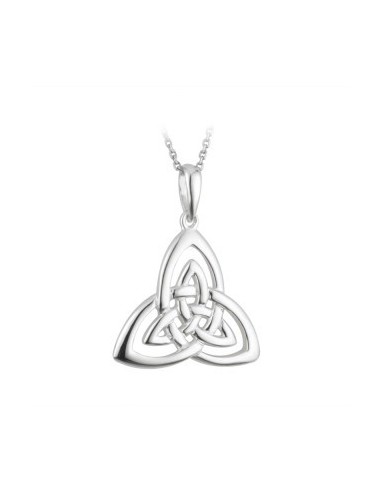
Celtic Silver Triquette pendant with 45 cms chain.
Last items in stock
€52.00
Tax included
The "Trinity Knot" is one of the most well-known symbols.
Made in Ireland. Silver. Includes chain of 45 cms.
Its meaning is divided by paganism and Christianity. In the first of them it means life, death and rebirth, in addition to the three forces of nature: sky, sea and earth. For Christianity it means the Holy Trinity, father, son and holy spirit.
Features of Silver Triquette Pendant.
Celtic Silver Triquette Pendant Made in Ireland.
Silver is a relatively light metal, so it is comfortable both to work with and to wear. It is the metal with the highest reflection index, making it ideal for creating exquisite jewelry. In our case, jewels that represent authentic historical icons of a rich and touching Irish past.
Our entire collection is made in Dublin (Ireland) by a family tradition jewelry that has been designing and making traditional jewelry with strong meaning for more than 70 years. Quality and design come together in pieces of Celtic ancestral inspiration and with a distinctly Irish character. Unique designs, based on icons of a millennial past: the Claddagh, Celtic crosses, the shamrock or the Celtic knot, adapted to current tastes and fashions.
Ancient Celtic and Irish legends survive today represented in exquisite designs created in Ireland and reflecting the enormous cultural wealth of this country.
Clover Pendant in Silver with Official Quality Guarantee.
Each piece of silver is marked with a contrast seal of the Assay Office from Dublin Castle, which guarantees that the silver used meets the most demanding quality standards. This seal has been in use in Ireland since 1637 and is a guarantee of purity.
CELTIC HAT AS A SYMBOL
Or "Trinity knot". It is difficult to reduce this symbol of such strength to a single meaning and to specify its origin. The best is his versatility, and is that it has been used in a variety of religions and even today has a new meaning.
Its potential meaning and its infinite symbolism makes practically each of us perceive it in a different way.
Centuries ago Irish monks used this symbol in their transcriptions using it as an ornament on their wonderful pages, but nevertheless already in the pagan times of the Celts they used it constantly.
The word comes from the Latin “three corners” although its exact origin is unknown, since it has also been found among the Indian heritage with more than 5,000 years old, or carved on stones of the VIII century A.D. in northern Europe, on Germanic coins, and even has some relation to Odin, a god of Norse mythology.
Historians disagree and even take opposing positions such as John Romilly Allen who believes in the pagan origin of the symbol or Francoise Henry who believes that the trick has a Christian origin by representing the Holy Trinity.
The CELTIC ORIGIN
It seems that these artistic drawings, known as KNOTWORK, they developed among the Celtic culture towards the seventh century, with several types of knots that move between the simplest to the most complicated, the triquette being the simplest knot among all of them.
This golden age of the triquette lasted until the Norman invasion (XII century) and its use began to decline until in the XV century the knots were again seen as part of a political and cultural identity and this symbol reappeared on weapons and jewelry. But it was not until the mid-nineteenth century when KNOTWORK decoration returned to be reproduced in numerous areas.
For the Celts the most important things in the world come in threes. The hat symbolized the threefold nature of the Goddess as a mother (creation), a maiden (innocence) and an old woman (wisdom), that is, the three stages of life. But he also represented the forces of nature: earth, fire and water, and even female fertility.
The hat also represents life, death and rebirth. It also represents the eternity, equality and indivisibility of everything that affects the universe.
Perhaps we can say in summary that the trick represents the Celtic philosophy of everything that has 3 levels: mental, spiritual and physical, or mind, soul and body.
On the other hand, he was also given healing powers, it was believed in his power to channel energy over a sick person.
In short, there is no concrete meaning since the Druids did not leave their beliefs written down and it was the oral tradition that brought them to us until today, with all the imprecision that this may entail.
THE CHRISTIAN MEANING
Some people claim that in the invasion of an already Christianized Roman Empire, the trick was usurped and given another meaning and symbology to dominate the Celtic Druids. They established the idea that it represented the trinity: father, son and holy spirit. And even, at the time of the Crusades and the Inquisition, it was considered a pagan and satanic symbol, and whoever wore it was burned.
Others understand that the monks created this symbol to try to convert the Celts to Christianity, but it seems clear that the origin is much earlier, much more ancestral.
MEANINGS
A symbol of Ireland's ancient culture
Symbol of eternal love
Symbol of the development of women, youth, motherhood and old age
It is a perfect gift in any of its meanings.
1 Item
Tap to zoom